6.2 Contribution margin
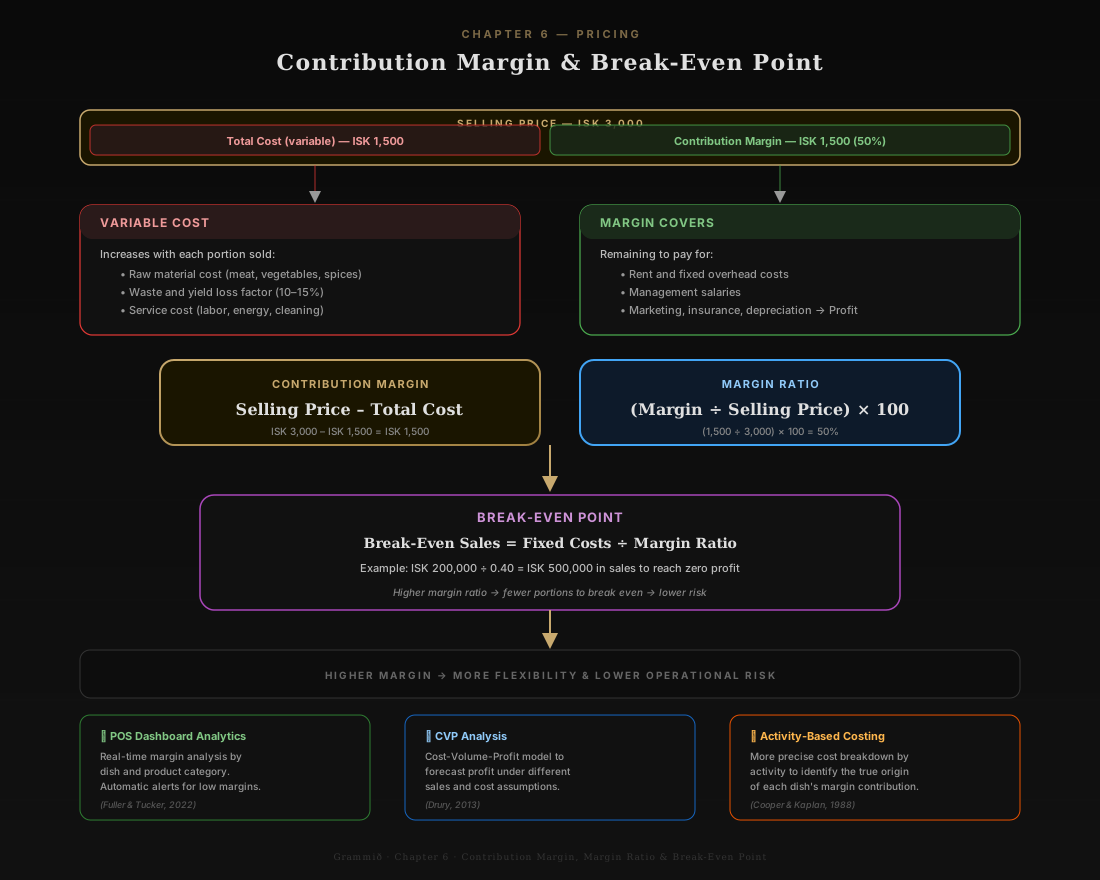
Contribution margin is the amount remaining from sales after all direct costs have been paid, that is, the cost of raw materials and the service associated with producing the dish. This is a key measure in operations because it shows how much money is available to cover fixed costs, such as rent, management salaries, and marketing, and to generate profit. When the contribution margin is high, the operation is better able to absorb fluctuations in demand and the risks associated with fixed costs.
Don’t mix up contribution margin and gross margin
In written form, the calculation of contribution margin can be explained as follows: To determine the contribution margin of a dish, we subtract its total cost, that is, its direct cost, from its selling price. If the selling price of a dish is ISK 3,000 and the total cost is ISK 1,500, then the contribution margin is ISK 3,000 – ISK 1,500 = ISK 1,500. This is the amount available to cover fixed costs and profit.
The contribution margin ratio indicates how large a share of each unit of revenue is available as contribution margin. It is calculated as the contribution margin divided by the selling price, multiplied by 100. In this example, the contribution margin ratio would be 1500/3000 × 100 = 50%. This ratio is used to compare dishes or product categories internally, regardless of differences in pricing, and to identify quickly which dishes contribute the most toward fixed costs and profit.
In addition, it is important to distinguish between variable costs and fixed costs. Variable costs increase with each portion sold, such as raw materials and service, whereas fixed costs remain unchanged regardless of sales volume, such as rent and management salaries. Contribution margin indicates how much of the revenue is available to cover fixed costs. The higher the contribution margin ratio, the faster the operation reaches the break-even point, where both variable and fixed costs have been covered.
To show how this works in practice, the break-even point may be expressed in written form as follows: “The point that separates loss from profit is found by dividing total fixed costs by the contribution margin ratio. In this way, the operation determines how much must be sold in order to reach a zero result.” For example, if fixed costs are ISK 200,000 per month and the contribution margin ratio is 40%, sales of 200,000/0.40 = ISK 500,000 are required to reach the break-even point.
Effects of an increased contribution margin: A higher contribution margin increases operational flexibility. If market conditions change rapidly, for example through rising raw material costs or changes in demand, it is crucial to have a strong understanding of contribution margin in order to respond quickly, for example through price adjustments, marketing actions, or new product offerings.
Tools and methods: To monitor contribution margin and the contribution margin ratio in real time, the following may be used:
Dashboard analytics in POS systems that display contribution margin by dish and product category.
Cost-Volume-Profit (CVP) analysis models to forecast profit under different sales and cost assumptions.
Activity-Based Costing (ABC) to provide a more accurate picture of costs and the origin of contribution margin.
By integrating these methods into daily operations, restaurants can improve efficiency, strengthen planning, and ensure a sustainable profit strategy.
Contribution margin shows what remains when total cost is subtracted from the selling price:
Contribution margin = Selling price – Total cost
Contribution margin ratio:
(Contribution margin / Selling price) × 100
A higher contribution margin provides greater room to cover fixed costs, such as premises and wages.
Subscription Required
You need an active subscription to use this feature. Send us a message and we'll get you set up.