8.4 HACCP and food safety
Food safety is a cornerstone of professional food service and demands a systematic approach at every stage — from the reception of raw ingredients to the moment a dish is placed in front of a guest. To ensure that staff master these processes and can apply them correctly in daily operations, it is important to combine two complementary methods: the visual representation of processes and a formal monitoring system. Visual tools such as flowcharts and proximity diagrams increase staff understanding and retention of complex procedures.
Visual data reduces cognitive load and helps staff commit the key steps to memory — inspection of packaging, temperature measurement, recording and final storage (Sweller, van Merriënboer & Paas, 2019).
When designing a flowchart, it is essential to use clear and standardised shapes: rectangles represent actions, hexagons represent decision points, and arrows indicate the direction of the process (Tufte, 2006). This standardisation ensures that staff at all levels can read and interpret the flowchart consistently, regardless of experience or background. Research further shows that interactive flowcharts — where more detailed descriptions, links to checklists and work instructions can be accessed directly within the chart — increase training speed and reduce errors in practice (Griffin & Hauser, 1993; Zhang, 2020). When an employee can consult precise instructions for each step in real time, the likelihood of mistakes decreases significantly.
Flowcharts are not merely training tools, however — they are also active instruments in continuous improvement work. Regular analysis of flowcharts, for example in connection with Lean Six Sigma reviews, helps identify bottlenecks, optimise processes and minimise waste (Rother & Shook, 2003; George et al., 2015). By reviewing processes regularly and updating flowcharts accordingly, a restaurant creates a continuous improvement cycle — from reception to delivery — in which every step is deliberate and documented.
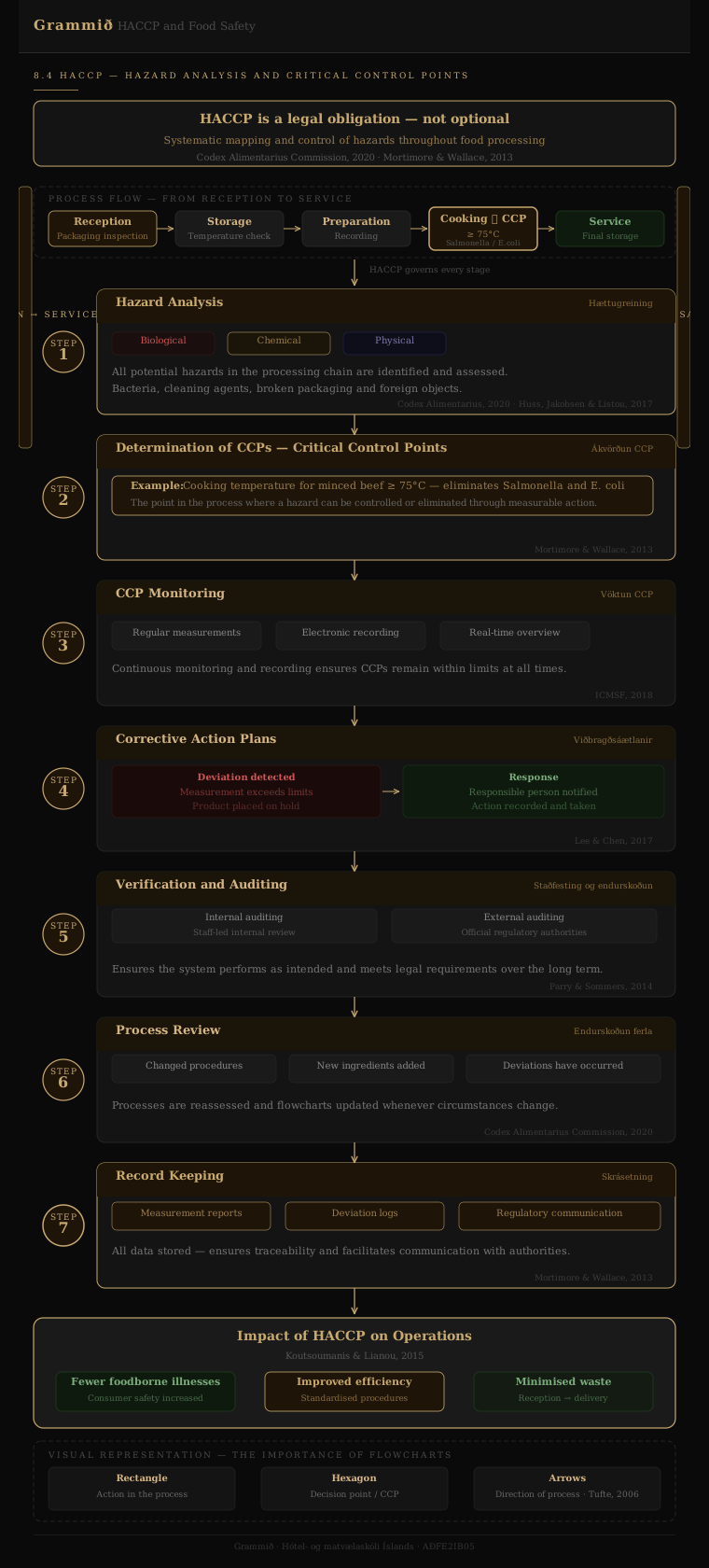
The key process that must be visualised and documented in this way is the HACCP system. HACCP (Hazard Analysis and Critical Control Points) is not optional: it is a legal obligation that applies to all food producers and restaurants to guarantee consumer safety. The system maps and controls risk factors in a systematic manner across seven steps, from the reception of raw materials through to service.
The first step is hazard analysis, in which all potential hazards of a biological (bacteria, viruses, parasites), chemical (cleaning agents, heavy metals) or physical (broken packaging, foreign objects) nature are identified and assessed (Codex Alimentarius Commission, 2020; Huss, Jakobsen & Listou, 2017).
Based on this analysis, the second step is carried out: the determination of CCPs (Critical Control Points) — those points in the process at which a hazard can be controlled or eliminated through measurable action. A classic example is cooking temperature: minced beef must reach ≥ 75 °C to safely eliminate Salmonella and E. coli (Mortimore & Wallace, 2013).
Once the CCPs have been defined, they must be continuously monitored — the third step — through regular measurements and recording in an electronic system that provides a real-time overview of safety status (ICMSF, 2018).
This monitoring system is only effective, however, if the fourth step is in place: clear corrective action plans that specify exactly who is responsible and what actions must be taken when deviations are detected (Lee & Chen, 2017). Without a clear division of responsibility, deviations can cause harm before any intervention takes place.
The fifth step is verification and review — both internal and external — to ensure that the system performs as intended and remains compliant with current legislation and regulations (Parry & Sommers, 2014).
This is closely linked to the sixth step, process review, which comes into play when working procedures change, new ingredients are introduced, or deviations have occurred that call for a reassessment (Codex Alimentarius Commission, 2020).
Finally, the seventh step — record keeping — forms the foundation of the entire system: all data is stored in reports that make traceability possible and facilitate communication with regulatory authorities (Mortimore & Wallace, 2013).
This comprehensive seven-step process is far more than a legal formality. When implemented with care, it reduces foodborne illness, improves kitchen efficiency and minimises waste by standardising operations at every stage (Koutsoumanis & Lianou, 2015). Together, visual representation and the HACCP system form a powerful partnership: flowcharts make the process visible and teachable, while HACCP ensures that it is safe and documented.